
- Minimum Plot Dimensions for DPL
Land Requirements for DPL Storage License
Before you buy or lease land for a chemical storage godown, check the minimum dimensions. A plot smaller than the requirement cannot be licensed for storage — no matter how good the construction is.
Minimum Requirement
Front 100 Feet × Depth 160 Feet — Minimum
This is the minimum plot size acceptable for a DPL storage license. The dimensions allow required safety distances, vehicle movement, firefighting access, and the godown structure itself. If your plot is smaller, the Explosives Department will not grant the storage license.
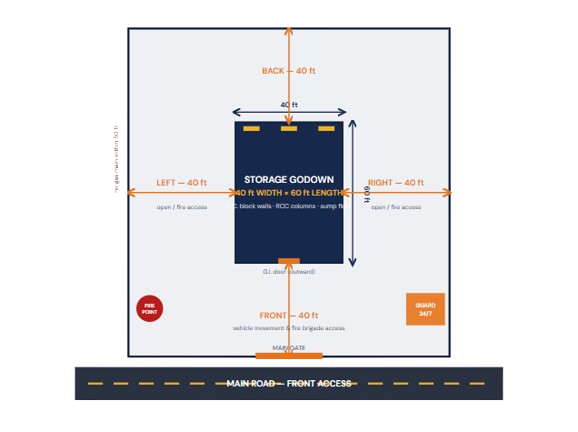
Sample Site Plan — Minimum DPL Plot
Godown of 40 ft × 60 ft placed in the middle of the plot, with 40 ft clear open space on all four sides — front, back, left, and right. Your actual approved plan (5 copies) is prepared by our engineers to Explosives Department specification.
Why 100' × 160' Minimum?
It's Not Just the Building
- Safety distances between godown, boundary wall, and neighbouring structures
- Open area for loading vehicles to enter, turn, and exit safely
- Fire brigade access around the storage structure
- 100 ft Front
- 160 ft Depth
- Minimum
Chemicals & Capacity on Final License
What Your License Actually Shows
- You may only store the chemicals and quantities printed on the license
- Adding a chemical or increasing capacity requires a license amendment
- We prepare your chemical list with MSDS and realistic capacities so ffm
- Chemical List
- Capacity Each
- On License
Important Note — Construction Responsibility
We strongly recommend that construction is done by our own team. If the godown is built by others and the dimensions or specifications do not meet Explosives Department requirements, the result is: inspection failure, demolition and re-work, project delays of months, and expenses that were never visible in the original quote.
When we take responsibility, we construct it ourselves — and we do it properly. One team, one quote, one responsibility: the plot is verified, the plan is approved, the godown is built exactly to specification, and the license is granted — with no hidden costs and no blame-shifting between contractor and consultant.
- Plot dimensions verified before any money is spent
- Plan approved by Explosives Dept before construction starts
- Built to pass inspection the first time — sump, ventilators, doors, fire systems
- Single transparent quote — construction + license together
- If we build it, we guarantee the license inspection
- No plot? Use our rental godowns — already compliant
Land Requirements for DPL Storage License in Pakistan
One of the most common — and most expensive — mistakes in the DPL process is buying or leasing a plot that is too small. The minimum acceptable plot for a chemical storage godown license is 100 feet front × 160 feet depth. This is a hard minimum: a smaller plot cannot accommodate the required safety distances, vehicle movement area, and fire brigade access, and the storage license will simply not be granted.
Check Before You Buy
Send us your plot details — dimensions, location, and surroundings — before you commit. Our free plot assessment confirms whether the land can be licensed, whether any gas main lies within 50 feet, and whether the District Authority NOC is obtainable at that location. Five minutes of checking can save you from buying unusable land.
Your Final License Lists Every Chemical with Its Capacity
The granted DPL license is not a general permission — it itemizes each chemical by name with its licensed storage capacity. Planning this list correctly at application time matters: under-license and your business is restricted; over-license and you pay unnecessary fees. We build your chemical-and-capacity schedule with you, backed by MSDS for each product, so the final license matches your real business needs.
My plot is smaller than 100 × 160 feet — can I still get a storage license?
Can I change the chemicals or capacities after the license is granted?
Why should construction be done by your team?
Check Your Plot Before You Spend
Free plot assessment — dimensions, location, NOC feasibility, and a transparent construction + license quote.